
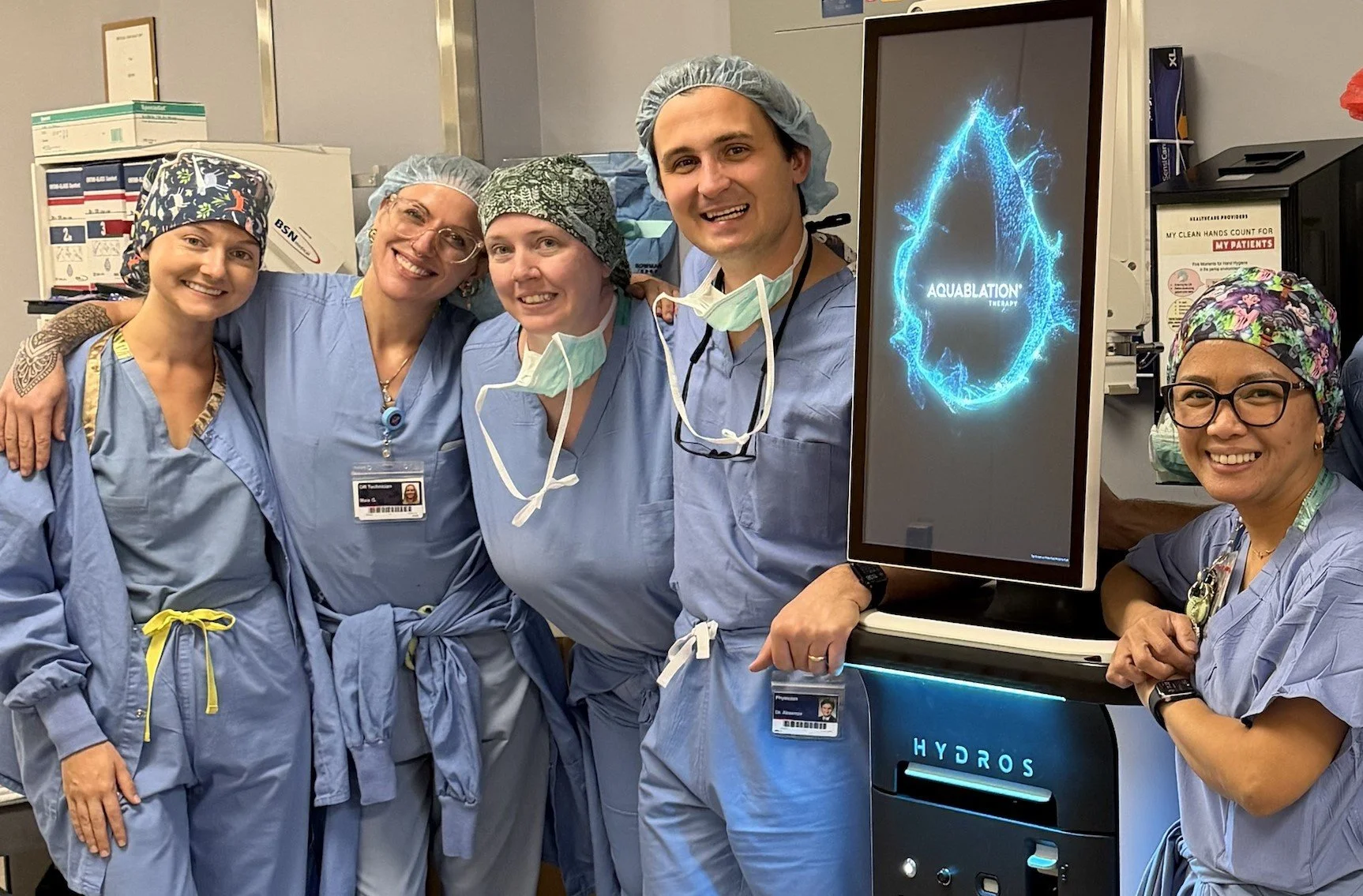
Patients with benign prostatic hyperplasia, commonly known as BPH or an enlarged prostate, now have a new option for treatment at Good Samaritan. Leonid Aksenov, MD, urology, now performs aquablation — an advanced, minimally invasive treatment that uses imaging, robotics and a heat-free waterjet to remove prostate tissue.
According to NIH, about a third of men age 65 and older will seek treatment for an enlarged prostate that’s causing difficulty during urination. The excess tissue either constricts the urethra and blocks urine flow, or it weakens the bladder to the point where it struggles to empty. Or both. Symptoms can interrupt daily life and prevent sound sleep. Leaving the condition untreated can cause significant bladder damage and kidney disease.
“One common theme I see is that many men chalk up BPH to ‘old age’ and tolerate their progressively worsening urinary symptoms,” Aksenov said. “We have great BPH surgical options that result in dramatic quality-of-life improvement and get patients off chronic medications. I have seen many patients after BPH surgery wonder why they didn’t get something done about this sooner.”
We sat down with Aksenov to ask him about this new tech and technique that BPH patients increasingly are requesting. At this time of this conversation, he had completed three aquablation cases at Good Samaritan.
Q: Why aquablation for BPH?
A: “Aquablation is a great treatment option for BPH because it provides great durable symptom relief with fewer sexual side effects, allows treatment of a larger range of prostate sizes, and has fewer urinary incontinence rates. Aquablation is also unique in that it uses real-time ultrasound to help plan the resection. This means the resection is tailored to each patient's anatomy and spares structures that matter for continence and ejaculation.
“While I do think aquablation is an excellent option for many men with BPH, it is important to note that it may not be the right choice for everyone. When we first see a patient for BPH, we perform a comprehensive workup to assess what BPH treatment option they would be a good candidate for.”
Q: Who might not be a good fit?
A: “Whenever we see a patient for BPH, they undergo an evaluation, and we engage in shared decision-making regarding medications and surgery to determine what best fits with their anatomy and goals. In fact, there are several patients who are not a good fit for aquablation.”
Aksenov listed for us these patients who are not a good fit for aquablation and should seek another therapy.
Patients with small prostates (<30cc) and very large prostates (>150cc)
Patients undergoing workup for prostate cancer
Patients with an active urinary infection
Patients who cannot safely pause anticoagulation
Patients with urethral or rectal anatomy that prevents access
Q: You just started performing aquablations at Good Samaritan and have completed three cases. How have they gone?
A: “All three cases have gone very smoothly, without any issues or complications. Each patient has gone home the next day and is recovering well. The team in the operating room has been stellar and got up to speed very quickly.”
Q: What can patients expect about time in the hospital and recovery time?
A: “Patients typically spend one night in the hospital. I am moving towards same-day discharge for well-selected patients. Patients have a catheter after the surgery. The catheter usually comes out within three days in clinic. Most men return to light activity within about a week but need to avoid heavy lifting and strenuous exercise for four weeks. Some urinary frequency, urgency or blood in the urine is common for the first few weeks as the area heals.”
Q: What can physicians do if they have a patient who may be interested?
A: “Physicians can refer patients to Colorado Urology at (888) 401-7149 and request their patients be scheduled at Good Samaritan. It’s helpful if they include recent PSA results and any prior BPH treatment history, if available.”