
Tiny patients, big results: NICU marks major safety milestones
By Patricia Billinger, Intermountain Health Communications
Some success stories are years in the making.
On June 2, the Saint Joseph Hospital NICU team gathered to honor two critical achievements that benefit the tiniest patients. After more than a decade of commitment to quality improvements, the unit is celebrating nearly two years without any instances of two of the most life-threatening infections in NICU babies.
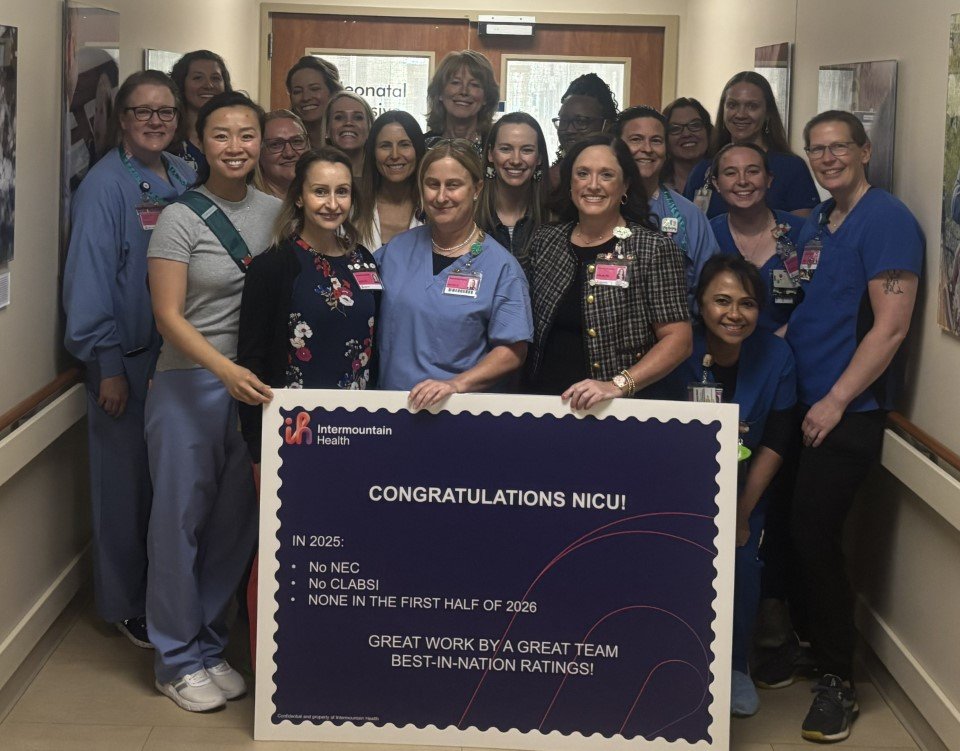
Saint Joseph Hospital NICU Team
“I am so proud of the hard work and dedication of each member of our NICU team and the amazing care we provide to our tiny patients,” said Ann Ryan, MD, Neonatal-Perinatal Medicine and NICU medical director. “I am especially grateful for the leadership of the neonatologists and NNPs on our infection prevention team and our neonatal nutrition team for guiding and supporting the work that led to our recent successes.”
Success #1: Preventing a devastating intestinal condition
Necrotizing Enterocolitis is a life-threatening intestinal condition that mostly affects premature babies, who have weaker digestive and immune systems. It happens when bacteria cause inflammation and cell death of the intestinal wall, which can create holes in the intestines that result in serious abdominal infections. According to the National Institutes of Health, it affects up to 5% of premature infants, with a mortality rate as high as 50%. Those who survive serious infections often suffer long-term health challenges.
In 2012, 3.7% of premature babies born at Saint Joseph developed NEC. An average of one child per year was dying from NEC. The hospital’s ‘Food for Thought’ nutrition committee made a goal of reducing the rate of NEC in the unit.
Although the cause of NEC is still unknown, infants who are fed breastmilk instead of formula have a lower incidence of the condition. So, over the course of several years, the NICU implemented interventions to get premature babies on breastmilk as soon as possible. This included education to promote mom’s milk and resources to help new moms with lactation and pumping. They encouraged new moms to start pumping milk earlier — as soon as two hours after recovery from giving birth. Recognizing that not every mom could produce enough milk, they ramped up the availability of donor milk and offered unlimited donor milk for babies born at 37 weeks or earlier. The team also standardized processes to reduce contamination and designated a clean area for mixing milk.
Improvements have prevented more than 100 cases of NEC and saved over $10 million over the past decade, according to Lynn Miller, NNP, lead neonatal nurse for Saint Joseph. “That figure doesn’t account for long-term treatment, ongoing care or the cost to society for the special needs that can occur in these children,” she said. “No value can be placed on the pain and suffering that’s prevented for infants and their families.”
The NICU maintained this improvement through 2025 despite the highest number of very-low birthweight infants in recent years. “During times of high patient volumes and inconsistent staffing, illness and death often increase,” Lynn said. “But for us, it did not. This just goes to show that highly engaged teams with evidence-based interventions and great team buy-in can make a huge difference for their patients.”
Success #2: Doubling down on infection prevention
The Saint Joseph NICU Bug Off Committee formed more than two decades ago to focus on infection prevention.
After a cluster of CLABSIs in 2024, Bug Off partnered with NICU leaders and caregivers to review unit practices. Led by Yin Stein, MD, Neonatal-Perinatal Medicine, the multidisciplinary committee reviewed central line care and updated the line change process based on current literature and national insights.
These changes required full re-education of the nursing team. Charge nurse Larisha Bartow, NICU manager Allie Wildenstein, and Nursing Professional Development specialist Erika Garber developed and rolled out mandatory education and simulation focused on maintaining safe zones and stringent cleaning and hygiene practices. A team of validators completed more than 360 check-off observations to ensure nurses were following the updated procedures.
“The validators’ dedication to the new workflow and accountability of their peers was the largest reason we had such success in implementation of the new line change process,” Wildenstein said.
Thanks to the multi-disciplinary structure of the improvement teams, some improvements came directly from frontline caregivers. Nurses shared that central line changes require deep focus, and interruptions can increase risk. So, the team made a practical change: They now place a sign on the door that says “sterile procedure in progress.” For that crucial window of care, everyone in the NICU – including families – knows to avoid distractions and let the nurse stay ‘in the zone.’
Tying the two big wins together, the NICU’s NEC-related efforts have also played an important role in preventing CLABSIs. Introducing breastmilk as early as possible helps reduce infection risk in a very practical way: When babies can be fed milk sooner, they often need IV nutrition for less time. That can mean less time with central lines in place — reducing the window of infection risk. In other words, mom’s milk can also be a safety strategy!
Ryan says everyone on the team should be recognized for both achievements and specifically mentions medical staff members Stein and Miller, along with Amanda Duran, NNP, Amber Gieri, MD, Neonatal-Perinatal Medicine, and Jorge Serna, NNP.