
How a New Training Model at St. Mary’s Cut Sharps Injuries in Half
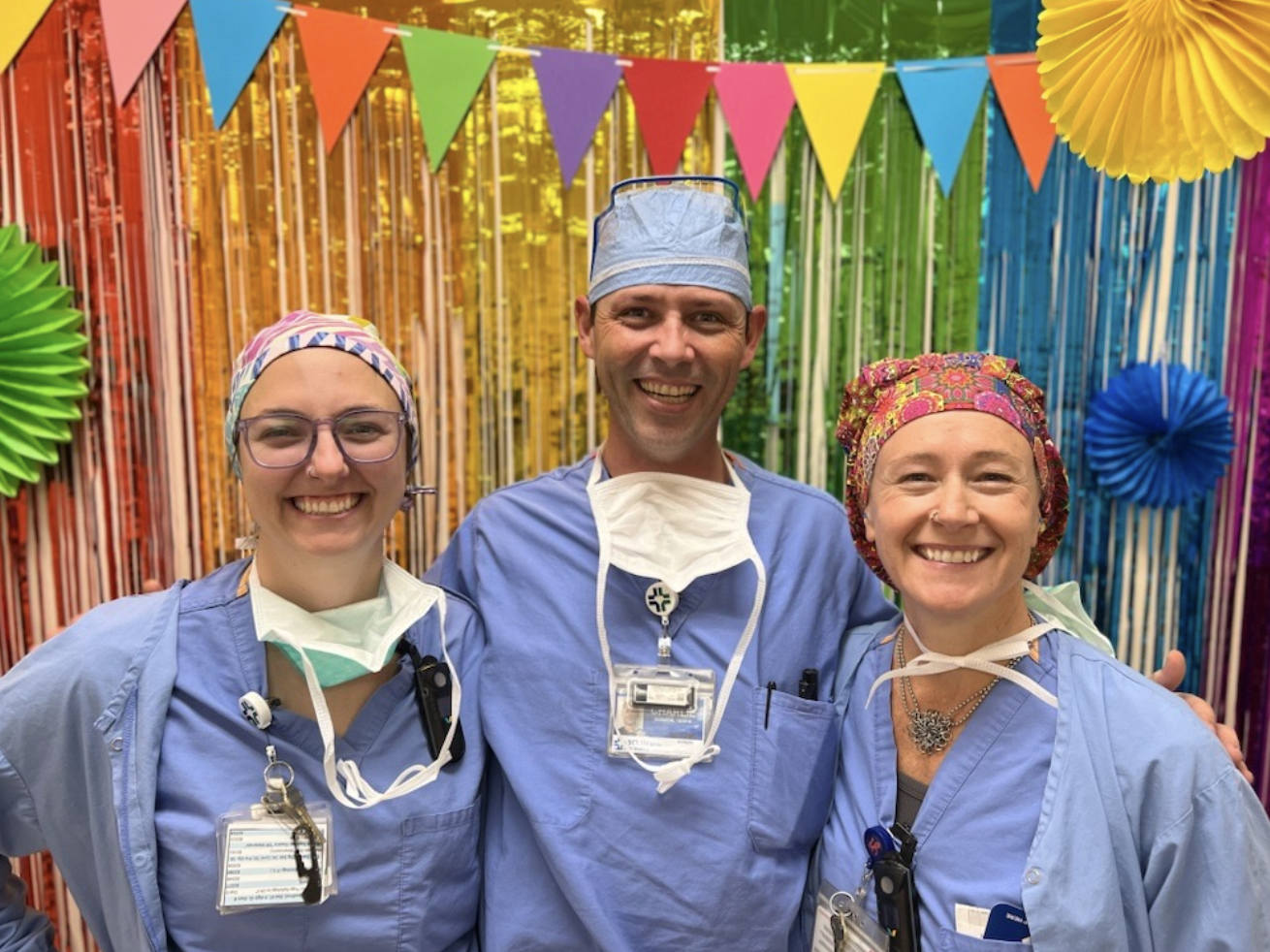
From left: Karley Kester, RN; Charlie Johnson, ST; and Carla Russell, RN
By Jenny Nailing (reposted from MyIntermountain)
When advanced practice providers (APPs) join the operating room at St. Mary’s Regional Hospital, many arrive highly educated and clinically skilled, but without extensive exposure to the operating room (OR).
Since St. Mary’s draws heavily from local physician assistant (PA) and nurse practitioner (NP) programs, many new APPs join the OR with limited surgical opportunities. Meanwhile, nurses and surgical technologists enter the OR after completing rigorous, months‑long orientations. The result was a knowledge and practice gap, which also carried real safety implications.
Prior to 2025, sharps injuries occurred frequently, with nearly half involving surgeons or APPs. Importantly, these incidents were not the result of individual negligence but rather reflected a broader opportunity to better align education and support with the realities of APP practice in the OR.
Identifying this gap prompted a collaborative effort across the neurosurgical and perioperative teams. With the neurosurgical service welcoming several new‑graduate APPs, the team recognized an opportunity to better prepare these clinicians for the realities of the operating room by providing consistent, foundational OR‑specific education.
Nurses, surgical technologists, APPs, surgeons, and educators came together to proactively strengthen safety, communication, and shared understanding within the OR environment.
“Our nurses and techs all speak the same OR language,” said Lauren Bleil, RN, nursing professional development practitioner and OR educator. “As our APP team continued to grow, we recognized the importance of ensuring they had access to that same foundational knowledge to support safety and confidence.”
Early efforts to address the gap occurred on a small scale, but momentum grew when the APP group, under the leadership of general surgeon Steven O’Day, MD, began meeting quarterly to discuss shared educational needs and opportunities for improvement.
Simultaneously, multiple members of the OR team stepped forward to help design a more structured and standardized onboarding experience. Surgical technologist Amanda Morgan, neurosurgery PA Salim Ghorayeb, and neurosurgical coordinator Carla Russel, RN partnered closely with perioperative leadership and educators to shape a program that reflected real OR workflows, team dynamics, and patient safety priorities. Together, their combined perspectives helped ensure that the onboarding approach was practical, inclusive, and aligned with the needs of the entire neurosurgical team.
From left: Karley Kester, RN; Charlie Johnson, ST; and Carla Russell, RN
What emerged from this collaboration was a comprehensive, three‑phase training model that has since become the standard for all new APPs entering the OR:
Phase 1: Hands-on sterile technique training: New APPs work directly with an experienced OR educator or surgical technologist to learn foundational OR practices: surgical scrub, gowning and gloving, sterile field management, sharps safety, and neutral zone use.
Phase 2: Service-specific equipment and workflow orientation: Clinical coordinators guide APPs through imaging systems, draping techniques, and safe patient positioning to help build confidence.
Phase 3: Mentorship with an APP champion: Each specialty now has at least one APP champion who ensures new hires complete their competencies and supports them shoulder-to-shoulder in the OR.
Measurable impact on safety and culture
The effects have been significant. In 2025, APP-related sharps injuries fell nearly 50% compared to the year before. “If you’ve never been taught sharps safety, you’re going to be at a higher risk of injury. The training simply gives people the information they deserve to keep themselves and their patients safe,” Lauren said.
Caregivers have also shared that new APPs now enter the OR with higher confidence, creating a more collaborative and less stressful environment for the entire team. For Lauren, that cultural shift has been the biggest win.
Her advice for other leaders looking to improve workflows or processes on their teams? “Step back and get curious,” she said. “Ask what people need instead of assuming they should just know. And stay humble. Everyone brings different strengths, and we take better care of patients when we help each other learn.”
A model for other teams
After early success with the new onboarding approach, the model quickly expanded across multiple specialties at St. Mary’s. “The neurosurgical team really piloted this practice, and then we fine‑tuned it so it would be transferable to all the other services,” Lauren said.
This work shows what’s possible when caregivers identify a gap, stay curious, and come together to solve it — creating a safer, more supportive environment for both patients and the people who care for them.